Most
Challenging Finishing Holes in South Carolina Announced for 2014
Golf
course architects often save their best of last, perhaps to give the
golfer a lasting memory of the layout, and the South Carolina Golf
Course Ratings Panel sought the most challenging finishing holes in
each region of the state.
Heading
the list for the Lowcountry and the state is the most recognized hole
in South Carolina, the 18th at Harbour Town Golf Links at Sea Pines
Resort on Hilton Head Island. The
other "Most Challenging" No. 18s: Upstate, Musgrove Mill Golf
Club, Clinton; Midlands, Orangeburg Country Club; Grand Strand, Wachesaw
Plantation, Murrells Inlet.
Each
one has the characteristics that can put an ugly number on the scorecard.
But, the golfer will remember them.
The
golf panel is composed of 125 golf enthusiasts from throughout the
state and represents a diverse range of occupations, handicaps and
backgrounds. The organization's objective is to promote excellence
in the state's golf course design and operations through the competitive
rankings, education and public advocacy. Judging criteria include
routing, variety, strategy, equity, memorability, aesthetics and experience.
In
addition to the toughest finishing holes, the best courses, public
or private, are selected in even-numbered years, and the best public
courses are ranked in odd-numbered years.
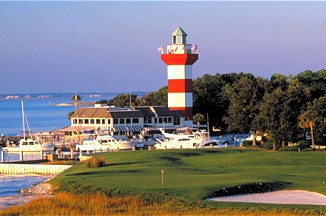
Harbour
Town Golf Links 18th
The "Most Challenging" Finishing Hole in SC |
LOWCOUNTRY
(AND THE STATE)
Harbour
Town Golf Links, Hilton Head Island, 472 yards, par 4
Thanks
to the PGA Tour's RBC Heritage being played over the Harbour Town
layout, this is almost certainly the most recognized hole in South
Carolina with the candy-striped lighthouse and yacht-filled marina
for a backdrop. The
landing area, framed by Calibogue Sound and marsh on the left and
condos and out-of-bounds stakes on the right, is generous, but the
second shot - a long iron into one of the course's trademark postage-stamp
sized green with water in play - is demanding.
Then,
there is the wind. A tough challenge on calm days, Harbour Town's
18th can be impossible into the wind. In one Heritage, Ernie Els played
the hole with a driver and 3-wood into the wind in the first round
and with a 3-wood and 8-iron with the wind at his back the next day.
Sea
Pines Resort V.P. of sports operations Cary Corbitt says: "Boo (Weekley)
chipped in to win from the left side and Davis (Love III) chipped
in from the right side. (Greg) Norman got up and down out of the back
bunker the year he won. A little bit of everything can happen on this
hole."
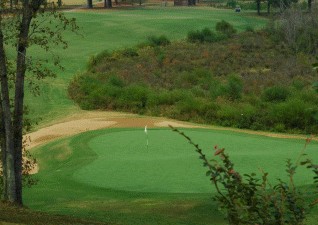
Musgrove
Mill's 18th Hole As Seen From The Clubhouse |
UPSTATE
Musgrove
Mill Golf Club, Clinton, 452 yards, par 4 The left side of the fairway
is guarded by marsh and the right side by a pine forest, but the landing
area is wide, perhaps 80-85 yards wide. A 250-yard drive still leaves
the golfer with a 200-yard shot to a huge three-tiered green guarded
by a waste area from the back left to the front right. Putts
from one tier to another can be adventurous.
Longer
drives can get extra yardage from roll on the down slope, but the
risk is coming up a bit short and facing a second shot from a downhill,
sidehill lie of 170 yards.
Pro
Jeff Tallman says: "Four is a birdie on that hole. It's a hole that
you want to have a two-stroke lead on. We put a flagstick in the cup
only to give golfers a little hope."
MIDLANDS
Orangeburg Country Club, 616 yards, par 5 A three-shot challenge for
all but the longest players, club officials usually play the hole
at a little more than 500 yards. The drive must avoid the fairway
bunker on the right that came back into play with the club's renovation.
The second shot must be precise to set up a short iron over a pond
to the green. A bunker at the end of the fairway provides more of
an aiming point than a hazard for the second shot. Pro David Lackey
says: "This hole creates legends for those who have reached the green
in two. Puddin' Powers, Rod Stroman, Jacob Burger and maybe Bob Varn
have done it. The list is very, very short." GRAND STRAND Wachesaw
Plantation, Murrells Inlet, 565 yards, par 5 Reaching the green in
regulation requires three good shots and accuracy is a must. A lateral
water hazard and marsh loom on the left and trees and out-of-bounds
stakes are on the right, and the fairway narrows for longer hitters
off the tee. Two deep bunkers will catch shots hit short and right
near the green and water is still on the left. To compound the challenge,
the green is banked toward the water and a low trajectory shot can
run into the hazard. If that's not enough, the green is narrow and
deep and any downhill putt is treacherous. Oh, and the hole slopes
toward the Waccamaw River, which can create depth perception problems.
Pro Joe Gagliano says: "Tight and intimidating. It's like a tunnel
with the water on the left and wrapping behind the green and the out
of bounds on the right. A tough finishing hole? We've got one." #
# #
Background
On SC Golf Course Ratings Panel
Overview
The
South Carolina Golf Course Ratings Panel is composed of golf enthusiasts
representing a diverse range of occupations, handicaps and backgrounds.
These individuals have been charged with the task of identifying the
best that South Carolina golf has to offer.
Objective
and Purpose
The
objective of the South Carolina Golf Course Ratings Panel is to promote
excellence in SC golf course design and operations through competitive
rankings, education and public advocacy. The Panel serves as an ambassador
for golf in South Carolina by striving to stimulate and facilitate
the promotion and marketing of outstanding golf courses, resorts,
and real estate developments.
1)
South Carolina’s 50 Best Courses – Bi-annually (in even-numbered
years) members of the Panel identify their choices for the “50 Best
Courses” in the state, public or private.
2)
The Best Courses You Can Play – Biannually (in odd-numbered
years) the Panel releases a listing of the best non-private courses
in the state. Every resort, public access, and daily-fee course is
eligible for this elite listing.
How
We Rate Them